Our Modern Foreign Languages department offers students the opportunity to learn both Spanish and French. Through engaging lessons and cultural experiences, students develop their communication skills, confidence and understanding of the wider world. Explore this page to learn more about our language curriculum.
Modern foreign languages
Learning Journey
Objectives in modern foreign languages:
Having a second language is essential to succeed in today’s global economy. Learning to communicate in another language gives you an insight into different cultures and traditions in other countries and helps you to develop other skills such as your confidence when speaking, actively listening, and communicating effectively with others.
We aim to ensure that all students can:
- Understand and respond to spoken and written language.
- Speak with increasing confidence.
- Read and listen confidently to native speakers.
In year 7:
Students studying French in year 7 are introduced to a wide range of vocabulary and topics such as hobbies, family, school, and pets. This introduces students to a variety of grammatical principles including infinitives, tenses, connectives and both simple and complex sentence structures which will lay the foundations of their future progress in languages. Each module tests students’ oral and written communication skills as well as their understanding of spoken and written French.
Our topics include:
- Introducing and describing yourself and others
- School
- Free time and hobbies
- Family
- Au Café
We expect that a year 7 student should be able to…
- Recognise and apply avoir & être verbs in the present tense
- Use simple connectives (et, mais)
- Give basic opinions (j’aime, etc)
- Understand and apply the adjectives with agreements in the correct position
In year 8:
Students develop their spoken and written French. They also continue to build on their vocabulary which helps them to understand more complex French. They find out interesting facts about Paris and its monuments, they learn how to describe famous people and their achievements as well as learning about various elements of French culture. Students continue to develop strategies to help them learn and their reading, writing, listening and speaking skills are assessed regularly. The grammar focus for Y8 is confident use of a wide range of adjectives, the present tense and past and future tenses, the use of a variety of connectives to expand sentences and the addition of opinions, reasons and justifications. Opportunities for extended writing also occur frequently throughout the year.
Our topics include:
- Holidays
- Festivals and celebrations
- Hobbies
- The world around me
- Sport
We expect a year 8 student to be able to…
- Use high frequency verbs in the present, future, and past tenses
- Use key structures, including ‘il y a/il n’y a pas de’ and ‘on peut’
- Use money and big numbers
- Use the imperative
In year 9:
Students will be focussing primarily on more complex grammatical structures in their written and spoken French, such as producing compound sentences and communicating in a range of tenses in different contexts. Students will be learning to speak and write in a variety of contexts, including their preferences with regards to the food they eat, their hobbies and extra-curricular activities, as well as watching and reviewing a French film. The range of topics covered focuses on students being able to include adverbs of time and connectives as well as giving students the opportunity to develop their ability to give and justify their opinions on these subjects. Students will be practicing their reading and listening skills through a variety of media as well as having the opportunity to develop their written and spoken communication skills through the curriculum, with the chance to sit GCSE style exams at the end of the year.
Our topics include:
- Opinions about hobbies and extra-curricular activities
- Future plans
- Musical tastes
- Food
- French speaking countries
We expect a year 9 student to be able to…
- Use and understand simple question words.
- Use negatives in the 1st person
- Use simple time phrases.
- Use simple connectives, opinions, and reasons
- Use simple expressions of points of view (1st person)
- Be able to apply the near future tense
- Use the past tense with avoir
- Use some être verbs in the past tense
- Recognise and apply adjectives in the correct position and apply the agreement rule
- Use reflexive verbs in the 1st person singular in the present tense
- Use commonly used irregular verbs in the 1st person in the present tense
- Understand sounds relating to graphemes
- Apply modal verbs in the 1st person
- Recognise / learn the application of: avoir/être/aller/faire in the present, past and future tenses
Year 10 GCSE French
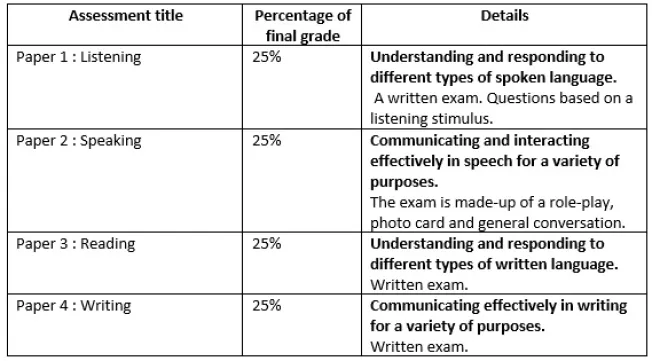
In Year 10 we begin the AQA French GCSE course. Students build and expand on what they have done in years 7-9 and work in the four skills areas of listening, speaking, reading and writing (which are each worth 25% of their final grade) Grammar points are also revised and expanded on over the duration of the course.
The course is split into 3 themes:
- Identity and culture (with the sub-themes of Me, my family and friends, Technology in everyday life, Free-time activities, Customs and festivals in French-speaking countries/communities)
- Local, national, international and global areas of interest (with the sub-cultures of Home, town, neighbourhood and region, Social issues, Global issues, Travel and tourism)
- Current and future study and employment (with the sub-themes of My studies, Life at school/college, Education post-16, Jobs, career choices and ambitions)
In Year 10 we cover the following topics:
- Qui suis-je? (talking about our family, friends and role models)
- Le temps des loisirs (talking about free-time activities such as sport, technology use, reading, TV and music, as well as what we do with our friends)
- Jours ordinaires, jours de fête (talking about festivals, traditions and celebrations, our daily life and shopping for food and clothes)
- De la ville à la campagne (talking about where we live and what we can do there, describing regions and finding out tourist information, as well as discussing weather and the pros and cons of living in the town and countryside)
- Le Grand Large (talking about holidays – where we go, what we do, as well as holiday disasters! We also learn how to book hotels, order food in a restaurant and use public transport).
Spanish
OUR Vision
Learning Spanish helps students communicate with others, discover new cultures and develop skills that will benefit them beyond the classroom. OUR curriculum builds students’ knowledge and confidence year by year, developing their listening, speaking, reading and writing skills alongside their understanding of Spanish grammar, vocabulary and pronunciation.
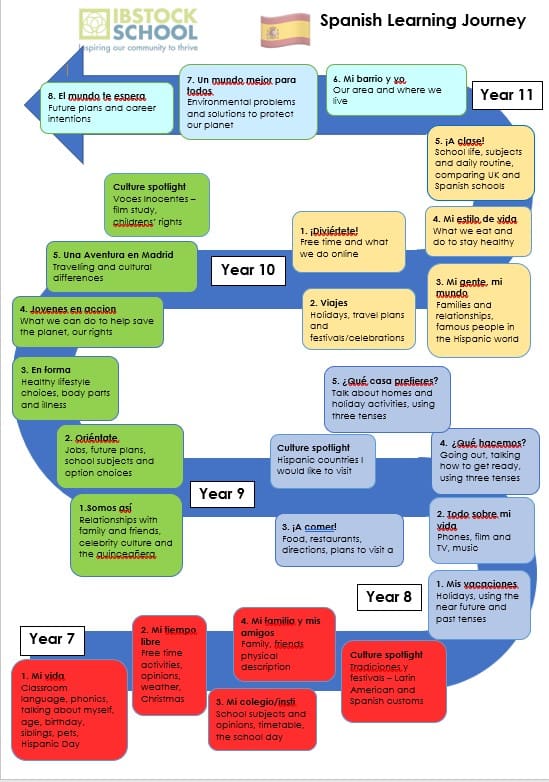
See OUR Spanish Learning Journey (attached to the email)
OUR Learning Journey by Year Group:
- Year 7 – Building Foundations:
Students begin by learning how to introduce themselves, describe their family and friends, talk about their interests and express their likes and dislikes. They learn to talk about school and free-time activities while developing their pronunciation and understanding of basic Spanish grammar. They also discover aspects of life and culture in Spanish-speaking countries.
- Year 8 – Developing Communication:
Students build on their existing knowledge and learn to communicate in more detail. Topics include daily routines, home and local area, holiday, food and healthy lifestyles. They develop their ability to give opinions and reasons, describe past experiences and talk about future plans, using a wider range of vocabulary and tenses.
- Year 9 – Preparing for GCSE:
Students extend their knowledge and begin to use Spanish more independently. They explore topics such as technology, relationships, social issues, the environment and future ambitions. They learn to express more complex ideas, use a wider range of grammatical structures and translate between Spanish and English.
- Year 10 – GCSE Spanish:
Students build the knowledge and skills required for success in their examinations. They explore a variety of topics linked to identity, lifestyle, popular culture, communication and global issues. Lessons focus on developing vocabulary and grammar while providing regular opportunities to practise listening, speaking, reading and writing. Students also develop translation skills and learn to produce more detailed, accurate and well-structured responses in Spanish.
- Year 11 – Consolidation and Examination Preparation:
Students build on their knowledge in preparation for their GCSE examinations. They revisit key vocabulary and grammar, practise examination-style questions and focus on areas where they need further support. Regular practice helps students develop confidence in speaking, improve the accuracy of their writing and strengthen their listening, reading and translation skills.
Beyond the Classroom
Finally, learning Spanish encourages students to be curious about the world around them and to appreciate different cultures and perspectives. Students may also have the opportunity to take part in a trip to Spain, where they can experience Spanish culture firsthand, develop their cultural understanding, and practise their language skills in authentic, real-life situations.