Dear Parent/Carer
We hope that your child has enjoyed their first half term at Ibstock School and is settling well into life in Year 7.
As part of our commitment to supporting every student to achieve their potential, we are now sharing your child’s Year 7 Settling In Report. This report provides an early picture of how your child has adapted to secondary school and is designed to support conversations at home about their learning, effort and engagement.
Later in the year, you will receive information about your child’s academic progress and will have opportunities to meet with subject teachers to discuss achievement in greater detail.
Accessing Your Child’s Report
Your child’s Settling In Report is available to view on the Arbor App under Report Cards.
The report includes information about two important factors that have a significant impact on success in school:
- Attendance – ensuring students are in school and ready to learn every day.
- Attitude to Learning – how students engage with their lessons, learning and the wider school community.
We encourage you to discuss these areas with your child, celebrating strengths and identifying targets for improvement where appropriate.
Understanding Attitude to Learning
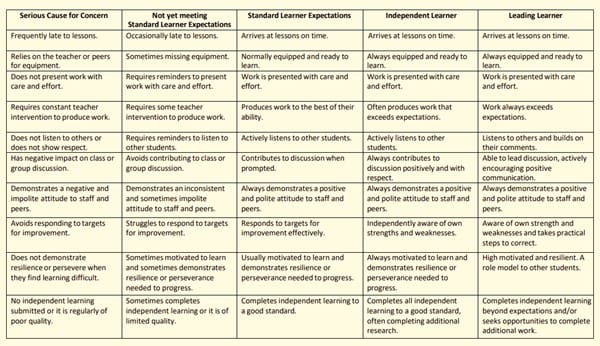
Attitude to Learning reflects the habits and behaviours that enable students to make strong progress in lessons.
Our grades are based on the school’s Standard Learner Expectations, which set out the behaviours we expect from all students. Some students consistently demonstrate behaviours beyond these expectations and may be recognised as Independent Learners or Leading Learners. The criteria for each Attitude to Learning category are included at the end of this letter to help you understand your child’s grades.
Education Elephant SWIFT Screening
As part of our transition programme, all Year 7 students have recently completed the Education Elephant SWIFT Screening. Your child’s SWIFT scores are available to view on the Arbor App under Report Cards.
SWIFT is a series of short digital assessments that help us understand how a student learns, rather than simply what they know. The screening provides valuable information about students’ learning strengths and any potential barriers they may face, enabling us to put appropriate support in place where needed.
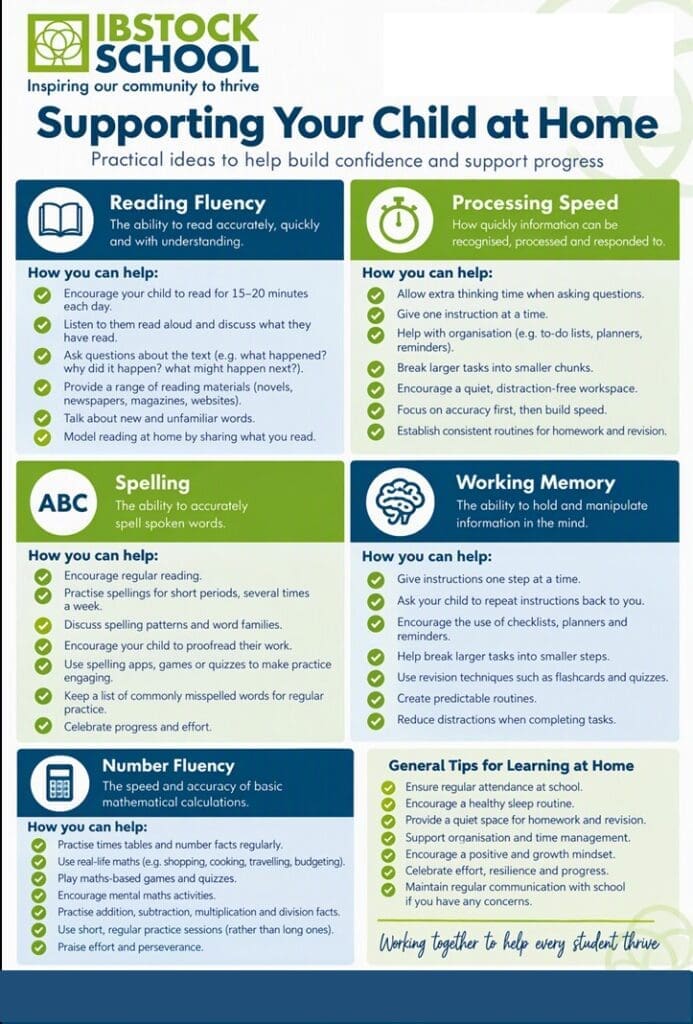
The screening assesses five key areas:
- Reading Fluency – the speed and accuracy with which a student reads and understands text.
- Processing Speed – how quickly a student can recognise, process and respond to information.
- Spelling – a student’s ability to accurately spell words.
- Working Memory – the ability to hold and manipulate information in the mind.
- Number Fluency – the speed and accuracy of basic mathematical calculations.
It is important to note that SWIFT is not a diagnostic assessment. Instead, it provides a holistic overview of learning strengths and needs, helping us tailor support for individual students where appropriate.
Understanding Your Child’s SWIFT Scores
To help you understand your child’s results, SWIFT provides standardised scores, which compare a student’s performance with that of other students of the same age.
- A score of 110 or above indicates that a student is performing above the typical range for their age in that skill area.
- A score between 90 and 109 falls within the typical range and suggests that the skill is developing as expected.
- A score of 89 or below may indicate that a student finds that skill more challenging than many of their peers and could benefit from additional support, strategies or classroom adaptations to help them access learning successfully.
These scores are considered alongside teacher observations, classroom performance and other assessment information to build a complete picture of each student’s strengths and learning needs.
Working Together to Support Your Child
At Ibstock School, we are committed to ensuring every student receives the support they need to thrive academically, socially and emotionally. Information from classroom assessments, teacher observations, attendance data, Attitude to Learning grades and the SWIFT screening allows us to identify strengths, remove barriers to learning and provide targeted support where necessary. This may include interventions to develop reading, literacy, numeracy, memory or organisational skills, alongside strategies that help students become increasingly independent learners.
We know that students achieve the best outcomes when school and home work together. Your encouragement, interest in your child’s learning, and regular conversations about attendance, reading, organisation and effort in lessons are invaluable. By working in partnership, we can ensure your child develops the confidence, resilience and learning habits needed for a successful start to secondary school and beyond.
Thank you for your continued support.
Kind regards,
Sarah Nelson
Assistant Headteacher